Seventy to 110 — the outline
The seven-part framework that shows up, in some form, in the histories of Japanese centenarians who arrived at their nineties in good shape. Medical care, nutrition, movement, social ties, purpose, tradition, and honest adaptation to decline.
Turning seventy in Japan means, statistically, that you have somewhere between 15 and 22 more years of life expectancy in front of you. Living all the way to 110 is not the average outcome, but it’s not fantasy either. Japan has more than 92,000 centenarians as of the most recent census, and the number keeps rising. About 89 percent of them are women — a striking imbalance that we’ll come back to.
What follows is a big-picture framework — not for what most people at seventy actually do, but for what the small number who make it to their late nineties and beyond in genuinely good shape tend to have in common. I’ve collected these observations from a decade of managing a Japanese day-care center, from the longevity research literature, and from conversations with residents who are proof of the argument.
1. Screening and preventive medicine
The Japanese health check system — tokutei kenshin — offers an annual free-or-low-cost examination that catches most of the drift toward serious disease before symptoms arrive. This is one of Japan’s underappreciated public health achievements.
What matters more than showing up is following up. A borderline blood sugar reading needs to trigger a real diet and movement change, not a shrug. A slightly elevated blood pressure needs to be trended over months rather than dismissed as white-coat effect. Cancer screening — colorectal, gastric, breast, cervical, lung when indicated — catches disease early enough for cure to be routine rather than heroic.
The centenarians I’ve cared for have almost universally had a family doctor they’ve seen consistently for decades. Continuity of medical care is itself protective.
2. Nutrition, in the specific Japanese pattern
Not any nutrition. Not the American 2000-kilocalorie-a-day standard applied to older Japanese bodies. Specifically:
- The ichijū-sansai structure — one soup, three dishes, plus rice — that provides balance without excess.
- Fish over red meat.
- Fermented foods (miso, natto, tsukemono, yogurt) every day.
- Vegetables in serious quantity — the 350 grams a day the MHLW recommends.
- Seaweed and small fish for minerals older bodies need.
- Green tea instead of sweetened drinks.
- Adequate protein, higher than younger adults need — 1.2 grams per kilogram of body weight, which many older Japanese adults don’t hit and should.
- The habit of stopping at 80% full — hara hachi bu — that Okinawan longevity researchers have written extensively about.
This isn’t a diet in the marketing sense. It’s a way of eating that a hundred generations of ordinary Japanese people have refined.
3. Movement, structured but not extreme
The healthiest ninety-year-olds I’ve cared for share a specific movement profile. They walk daily — 30 to 60 minutes, most days. They do some kind of gentle strength work — often gardening, sometimes tai chi, occasionally what younger people would call strength training. They preserve balance actively, whether through single-leg standing at the sink or through tai chi practice.
None of them run marathons. None of them lift heavy weights. What they do is move consistently, at moderate intensity, most days, for decades.
4. Social participation
This one is underappreciated in the popular longevity literature. The 92,000 centenarians in Japan are not, on the whole, hermits. They live in families, or in facilities where relationships are cultivated, or maintain neighborhood ties into extreme old age.
The Holt-Lunstad meta-analyses put chronic loneliness in the same mortality risk category as smoking. The Whitehall II data links social isolation to dementia risk. Whatever else you do in your seventies, keeping human contact alive is not optional.
Practically: at least one face-to-face contact per week, some kind of group affiliation (choir, garden, temple, senior center), and family that actually shows up.
5. Mental and spiritual practice
The Japanese term ikigai — a reason to get up in the morning — turns out to have real epidemiological support. Sone and colleagues at Tohoku University followed 43,000 Japanese adults and found roughly 15 percent lower mortality among those reporting a sense of purpose.
What matters isn’t grand purpose. It’s daily-life meaning. The tomato plants. The choir practice. Watching a grandchild grow up. A ritual of morning tea. The specific things vary, but the pattern doesn’t.
Alongside this, most of the very old people I know maintain some form of contemplative practice. Not always religious. Often just the daily bow at the family altar, the visit to a grave, the moment of silence before a meal. Something that quiets the mind briefly and reminds them what they’re part of.
6. The traditional Japanese way of life, still
Several traditional practices contribute to Japanese longevity in ways that are easy to overlook.
The evening bath (ofuro). 15 to 20 minutes at 38 to 40°C activates the parasympathetic nervous system, aids sleep, and — done regularly — associates with lower cardiovascular mortality in Japanese cohort data.
The morning greeting (ohayō gozaimasu) exchanged with neighbors. Trivial-seeming, but socially structuring. Weak-tie research from Stanford’s Gillian Sandstrom shows that even brief contact with acquaintances substantially raises daily well-being.
The daily radio calisthenics (rajio taisō), broadcast at 6:30 every morning since 1928, and still done by millions of older Japanese in parks and living rooms.
The habit of walking places rather than driving, in the many Japanese communities where this is still feasible.
None of these are dramatic. All of them add up.
7. Managing decline honestly
The centenarians I’ve known who did best were not the ones who denied every sign of aging. They were the ones who acknowledged decline as it happened, adjusted, and kept engaged.
Hearing aids when hearing dropped. Cataract surgery when it interfered with reading. A cane when balance became unreliable. Handrails installed at home before falls, not after. Care services accepted while there was still time to choose the right ones. The 2023 ACHIEVE trial showed 48% less cognitive decline in high-risk older adults given hearing aids — an intervention many people delay for years out of vanity.
Growing old well is not the absence of loss. It’s the practice of adapting to loss without letting it collapse the rest of what still works.
The pattern, if there is one
Consistency across decades. Diversity of small habits — food, movement, social contact, purpose. Continuity of medical care. Acceptance of help when needed. Cultural rituals that structure the days. And — this is the one nobody sells — sheer luck, in the form of good genes and no catastrophic events.
You cannot control the luck. You can control the consistency. Starting today, at seventy, is not too late for meaningful gains. Ten years of consistent healthy habits does more than fifty years of theoretical intention. The centenarians in Japan are proof of this in aggregate. The bet is worth making.
References
- MHLW, National Statistics on Centenarians (annual publication).
- Sone T et al. Sense of life worth living (ikigai) and mortality in Japan: Ohsaki Study. Psychosom Med, 2008.
- Holt-Lunstad J et al. Loneliness and social isolation as risk factors for mortality. PPS, 2015.
- Ukai T et al. Habitual tub bathing and risk of cardiovascular and all-cause mortality. Heart, 2020.
- Lin FR et al. Hearing intervention versus health education control to reduce cognitive decline. Lancet, 2023.
📖 New book by the author of this site
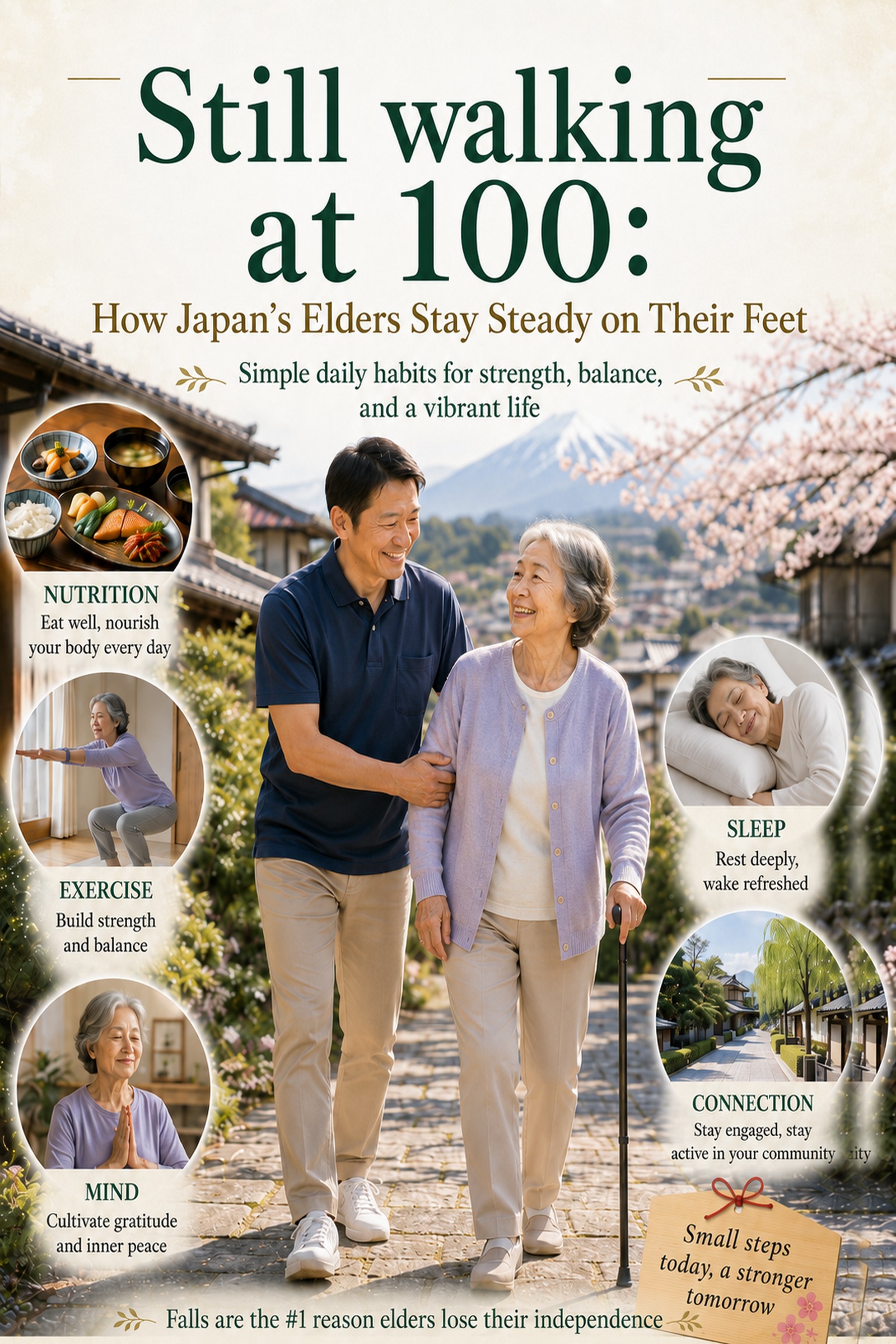
Still Walking at 100: How Japan’s Elders Stay Steady on Their Feet
Kindle $3.99 · free with Kindle Unlimited
Learn more
コメントを残す