A week of movement, in five parts
The chair program, the handrail program, the rainy-day program, the park program, and walking done properly. Fifteen minutes on a bad day, forty-five on a good one. Most weeks, not every week.
Nobody feels ready to start exercising in their seventies. There is always a reason not to — the knees, the rain, the sense that you should have started years ago and didn’t, the vague embarrassment of doing something in front of family that they associate with young people. All of these are real, and none of them go away by themselves. The workaround is not to defeat them. The workaround is to design a routine that assumes their presence and works anyway.
This is a consolidated five-part program that came out of a Japanese day-care center’s practice guide. Each part addresses a specific situation — a rainy day, a good day at the park, a shaky balance day at the sink. Together they cover the range of an ordinary week, and they work for people in their seventies, eighties, and beyond.
Part 1: The chair program (15 minutes)
This is where everyone starts. Even the frailest resident at our center can do most of this seated in a stable chair. The chair supports you, so balance is never at risk, and everything can be modified by reducing the number of repetitions.
Flexibility, 5 minutes
- Neck rolls — five to the right, five to the left, slowly.
- Shoulder shrugs — bring both shoulders toward the ears, hold three seconds, release, ten repetitions.
- Side stretch — one arm overhead, lean the trunk to the opposite side, five each direction.
- Ankle circles — ten each foot, both directions.
Strength, 5 minutes
- Knee lifts — alternately lift each knee high, ten each side.
- Knee extensions — straighten one knee at a time, hold three seconds, ten per side.
- Heel and toe raises — sitting, alternately lift heels and toes, twenty repetitions.
- Chair squats — using the backrest for support, stand and sit slowly, ten times.
- Abdominal draw-in with rotation — five to each side.
Aerobic, 5 minutes
- Seated march — vigorous foot marching for one minute, rest thirty seconds, repeat three times.
- Punches or arm swings while marching — adds upper-body work.
Fifteen minutes covers all three energy systems. This program alone, done three times a week, produces measurable improvements in most seventy-year-olds within eight weeks.
Part 2: Using a table or handrail (10 minutes)
Once you can do the chair routine comfortably, the next step is standing work with a stable support. A dining table edge, a kitchen counter, or a proper handrail. The support catches you if you lose balance, so you can push closer to your actual limits than you could freestanding.
- Standing heel raises — twenty repetitions, holding the support lightly.
- Standing knee lifts — ten each side, holding for a moment at the top.
- Single-leg stand — start with ten seconds each side, work up to a minute.
- Wall or countertop push-ups — ten repetitions.
- Standing side-leg lifts — ten each side, hip out to the side.
- Squats to a chair — squat toward a chair, hover briefly, stand back up, ten times.
This routine bridges the chair program and freestanding work. If your balance has been shaky, this is where most of the improvement happens.
Part 3: The indoor rainy-day program (15 minutes)
For weather that keeps you inside, or a Japanese summer where midday outdoor activity is genuinely dangerous. Requires nothing but your own body and a bit of clear floor space.
- Marching in place, arms swinging — 3 minutes, moderate intensity.
- Stepping forward and back — one foot forward, one foot back, alternating, 2 minutes.
- Slow squats — 10 repetitions, hold the chair back for support if needed.
- Wall push-ups — 10 repetitions.
- Standing balance — feet together for 30 seconds, then heel-to-toe for 30 seconds.
- Stretching sequence — the flexibility work from Part 1, standing.
Rainy days used to be a break in the routine. They don’t have to be. This program keeps the habit alive on days when the outdoors is off the table.
Part 4: The park program (30 minutes)
When the weather is good, take the routine outside. Two things happen. First, sunlight — which supports vitamin D and circadian rhythm. Second, people. Parks with older adults exercising in them are a real social institution in Japan, and the connection is as much of the benefit as the movement.
Structured
Most Japanese public parks have exercise equipment installed — pull-up bars, twist devices, leg-press benches. Circuit through what’s available, doing 10 repetitions of each with rest between.
Free-form
Radio calisthenics groups (rajio taisō) meet in most Japanese neighborhoods at 6:30 in the morning. Show up. The broadcast is on national radio, so you don’t need to remember anything. Ten minutes of guided movement, followed by tea or conversation with regulars, is one of the more sustainable exercise habits available anywhere.
Nature-based
Walking with attention. Notice the plants, the birds, the small changes each week. This isn’t performance — it’s presence. Forest bathing research suggests measurable benefits for cortisol and blood pressure from this kind of attentive time in green spaces.
Part 5: Walking, done properly (30–45 minutes)
The bedrock. If you did nothing else on this list, walking well, most days, would still cover most of the benefits.
Form
Head up, chin level, looking about ten meters ahead. Shoulders relaxed. Arms bent naturally, swinging opposite the leg. Stride slightly longer than you’d default to. Heel strike first, then roll through to the toe.
Pace
Moderate intensity — you can talk but not sing. Roughly 100 to 120 steps per minute, or 4 to 5 km/h.
The interval variant
The Shinshu University protocol: 3 minutes at comfortable pace, 3 minutes at brisk pace, alternating for 30 minutes. In their trials, this produced significantly greater improvements than steady-state walking of the same duration.
Timing
Post-meal walking, starting 30 minutes after eating, flattens blood-sugar spikes measurably. If you have prediabetes or diabetes, this is the single highest-yield timing for you.
How to sequence the five over a week
A workable pattern for a beginner:
- Monday — Part 1 (chair, 15 min) + short evening walk.
- Tuesday — Part 5 (walking, 30 min).
- Wednesday — Part 3 (indoor, 15 min).
- Thursday — Part 5 (walking, 30 min).
- Friday — Part 2 (table/handrail, 10 min) + short walk.
- Saturday — Part 4 (park, 30 min), if weather permits.
- Sunday — light stretching from Part 1.
You don’t have to hit every day. Missing sessions is fine. What matters is that the routine remains alive as a habit — that the default assumption for the week includes movement, most days, at some level. Whether it’s 15 minutes or 45 doesn’t matter as much as whether it happens.
Some general rules
Warm up before, cool down after. Two minutes of easy movement bookends every session.
Drink water before and after. A cup each time. Your thirst signal is unreliable.
Don’t hold your breath during effort. Exhale on the working phase, inhale on the release.
If it hurts, stop. Mild fatigue is fine. Joint pain or sharp muscle pain is not.
Increase gradually. A 10 percent increase in duration or repetitions per week is safer than sudden jumps.
What this actually delivers
If you followed this program most weeks for six months, based on published trials, you could expect: walking speed up meaningfully, chair-stand time improved 20 to 40 percent, standing balance noticeably better, blood pressure lower, blood sugar more stable, sleep improved, mood improved. Not dramatic single-metric changes. Cumulative, meaningful, and — most importantly — sustainable.
Fifteen minutes on a bad day. Forty-five on a good one. Most weeks, not every week. That is the whole framework, and it is enough.
References
- Nemoto K et al. Effects of high-intensity interval walking training on physical fitness and blood pressure in middle-aged and older people. Mayo Clin Proc, 2007.
- Sherrington C et al. Exercise for preventing falls in older people living in the community. Cochrane, 2019.
- Fielding RA et al. American College of Sports Medicine position stand: Progression models in resistance training for older adults. Med Sci Sports Exerc, 2011.
- MHLW, Physical Activity Reference for Health Promotion 2023.
📖 New book by the author of this site
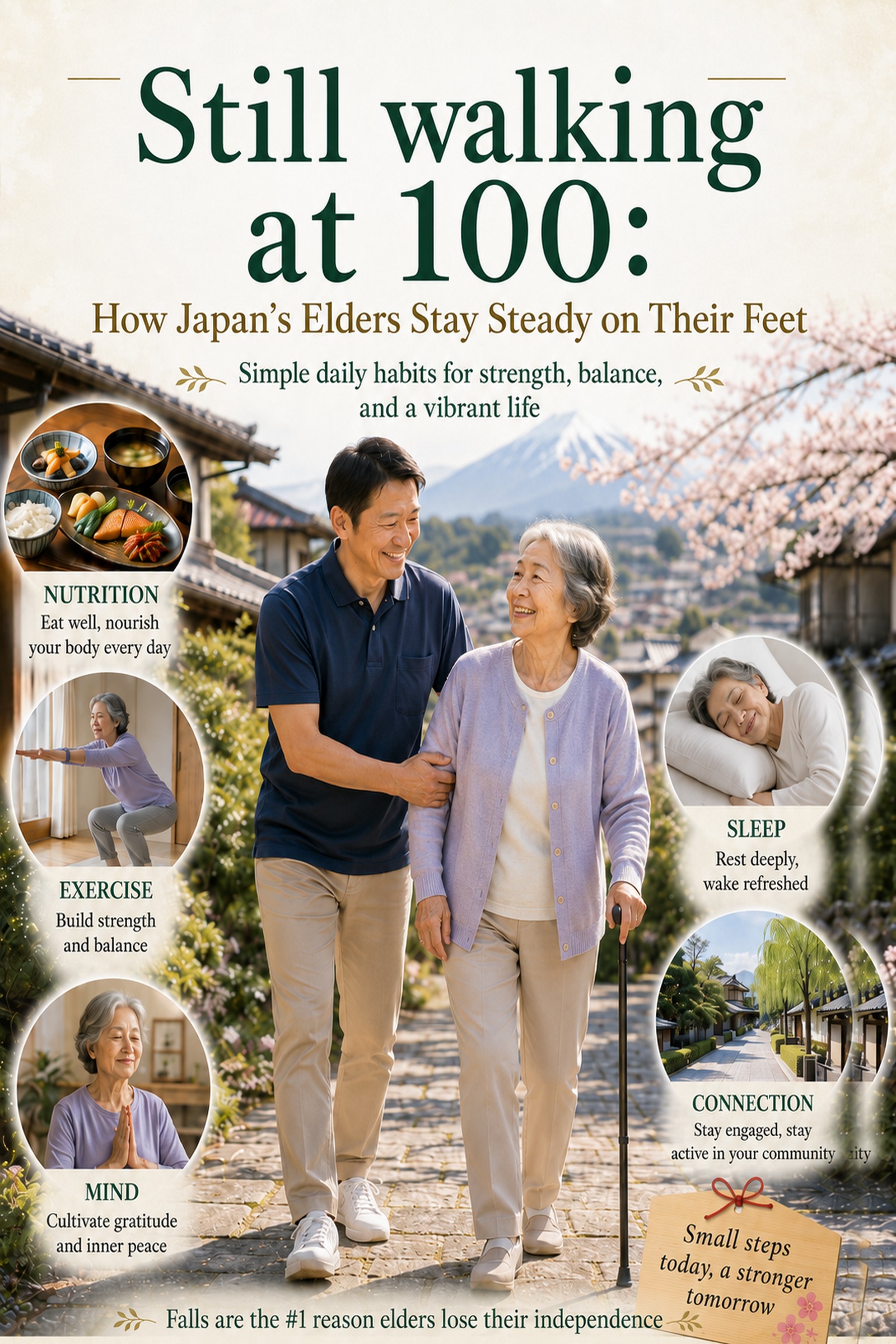
Still Walking at 100: How Japan’s Elders Stay Steady on Their Feet
Kindle $3.99 · free with Kindle Unlimited
Learn more
コメントを残す