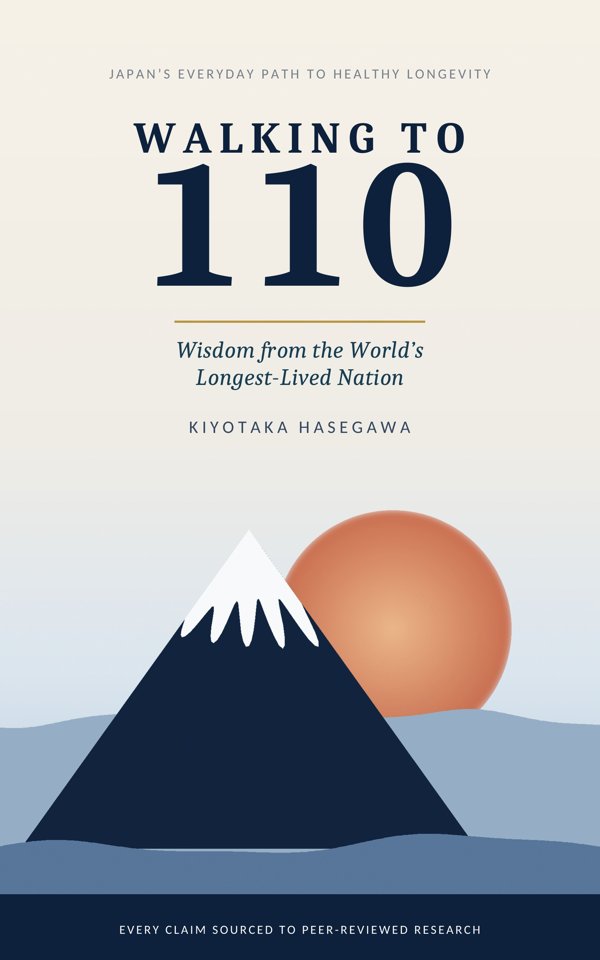
For three days — August 21 to 23 — the Kindle edition of Walking to 110: Wisdom from the World’s Longest-Lived Nation is free.
Where the book starts
In 1965, researchers began following Japanese men in three places: Japan, Hawaii, and San Francisco. Same ancestry, same starting point, three different lives. Decades later the results split cleanly along geography — the further the men drifted toward a Western way of living, the more coronary heart disease they developed.
That study, Ni-Hon-San, is where this book begins. If people with identical genes end up with different outcomes, then genes aren’t what’s deciding. Daily life is. And anything that comes down to daily life can be learned, copied, and practiced — in Osaka, Ohio, or Oxfordshire.
What’s inside
I spent ten years working in elder care in Tokyo and Kanagawa, latterly managing a day-service centre. The question that stayed with me was why some people are still walking, still cooking, still themselves at ninety, while others lose those years. This book traces each habit to its evidence: the table built on beans, fish and plants; six to eight thousand daily steps; the warm bath before bed; the checkup before symptoms appear; the hobby circle that halved dementia incidence in a landmark Japanese cohort; the moai that keeps loneliness at bay; care shared between human hands and helpful machines; and the old restraint of knowing what is enough.
Every claim rests on peer-reviewed research or official statistics. No fads, no supplements to buy, no miracle foods. And every practice is translated out of its Japanese form into ingredients and routines you can find wherever you live.
Free August 21–23, 2026 (Pacific Time). After that it returns to $4.99, and remains free to read with Kindle Unlimited. A paperback edition is also available. As an Amazon Associate we earn from qualifying purchases.
If you read it, an honest review on Amazon would mean a great deal — it’s how books like this one find their readers.
コメントを残す