Five exercises for the moment your toe catches on something
Heel raises, chair squats, single-leg stands, backward leg raises, toe raises. Fifteen minutes a day, close to a wall, and the specific muscles that decide whether a stumble is a scare or a fracture.
Most falls, at least the ones I’ve seen up close over ten years in this field, don’t happen because somebody was doing anything reckless. They happen because a person’s foot didn’t clear a rug edge, or a person went to stand up and their leg didn’t quite have the strength they assumed it did, and momentum did the rest. The tools you need to prevent this are not exotic. They are five specific exercises that build the muscles falls test.
What follows is a routine you can do next to a chair or a wall, at home, in the amount of time it takes to make a cup of tea. It’s aimed at people in their sixties, seventies, and eighties. Nothing here needs equipment.
Why the legs get weaker
Three overlapping mechanisms.
Sarcopenia. Muscle mass falls if you don’t train it. By seventy, the average person has lost roughly a third of the muscle they had at thirty, and the lower body has lost the most. The specific muscles that carry you — quadriceps, gluteal, calves — respond to the same stimulus at seventy that they did at thirty, but only if the stimulus arrives.
Balance sensors go quiet. The inner-ear apparatus and the pressure sensors in the soles of the feet both dull with age. The brain has less real-time information about which way the body is tipping, and less time to correct.
Reaction time slows. A stumble at forty was caught by a stepping foot in a quarter of a second. At seventy the same signal takes longer to travel, and by the time the foot moves the balance is already lost.
What strength training does is compensate for all three. Stronger legs need less balance correction to stay upright. Better muscle proprioception partly replaces the ear signal. And practiced movements shorten the reaction path itself.
Five exercises
1. Heel raises (calf raises)
Muscles trained: Calves (gastrocnemius, soleus).
The calves are the second heart — the pump that returns blood from the legs — and they’re also what pushes you off with each step. Weak calves mean shuffling gait, and shuffling gait means catching toes on things.
Stand behind a chair or at a counter, holding lightly for balance. Rise slowly onto your toes. Hold two or three seconds. Lower slowly. Ten to fifteen repetitions, two sets a day.
The key word is slow. Fast heel raises train speed. Slow ones train strength. You want strength.
2. Chair squats
Muscles trained: Thighs (quadriceps), hips (gluteals).
The quadriceps are what let you get out of chairs, off toilets, and up from the floor. Losing them is the single most direct route to needing help with everyday life.
Stand in front of a chair, feet at shoulder width. Extend your arms in front for balance. Lower slowly as if to sit — stop just before your bottom touches the chair, or lightly touch and rise. Ten repetitions per set, two sets a day.
Watch that your knees don’t jut significantly past your toes. Keep your weight over your heels. If ten is hard, use your hands lightly on the chair back and do what you can.
3. Single-leg stands
Muscles trained: Ankle stabilizers, hip stabilizers, deep core.
This is a balance exercise disguised as a strength exercise. The muscles that keep you upright on one foot are exactly the ones that catch you when you start to fall.
Stand next to a wall or counter, holding lightly. Lift one foot slightly off the floor. Hold ten seconds. Switch. Work up to a full minute per side over weeks.
The physiological standard used in geriatrics — being able to stand on one leg for 20 seconds — turns out to be one of the strongest predictors of fall risk. Get to that, then push further.
4. Backward leg raises (hip extensions)
Muscles trained: Glutes, hamstrings.
The glutes are underworked in most modern lives. They’re also central to stable walking, hip alignment, and low-back health.
Stand behind a chair, holding the back for support. Keeping the standing leg straight and the moving leg straight, lift one leg backward without leaning forward. Ten to twelve repetitions per side, two sets a day.
The movement is small — 20 to 30 degrees is plenty. What matters is keeping the torso upright and the movement controlled.
5. Toe raises
Muscles trained: Shin (tibialis anterior).
The shin muscle lifts the front of your foot when you walk. If it’s weak, the foot drops, you scuff the ground, and any tiny obstacle becomes a trip.
Sit in a chair with feet flat. Keep heels on the ground. Lift the toes and the front of the foot as high as possible. Lower slowly. Ten per foot, two sets.
You can do this one standing too, holding a support. Standing versions add a small balance challenge.
The schedule
Five to seven days a week is the target. Rest days are useful for recovery, but at these low intensities, daily is fine.
Fifteen minutes covers the whole routine done twice through. First thing in the morning works well because you’re less likely to skip it later in the day. Pairing it with an existing habit — the morning tea, the news broadcast, tooth brushing — improves consistency dramatically.
Progression
Week 1-2: One set of each exercise at the lower end of the rep range.
Week 3-4: Two sets of each at the same rep count.
Week 5-6: Increase repetitions by two or three.
Week 7-8: Try one exercise without holding the support (with the support close by).
Beyond: Small ankle weights, longer holds, higher rep counts.
The one thing not to do is stay at the starting level forever. Muscles adapt to the load you give them, and if the load doesn’t rise, neither does the strength.
What can go wrong
Sharp pain, at any point, means stop. Muscle soreness the next day is fine. Joint pain or persistent stiffness is not.
Dizziness on standing up is a real concern in older adults, particularly those on blood pressure medications. Stand up slowly, pause at the edge of the chair, then move.
Holding your breath during effort spikes blood pressure. Exhale on the working phase, inhale on the release. Say it to yourself out loud the first few sessions until it becomes automatic.
What this actually buys you
The trials on programs like this are decades old and consistent. Six months of a basic lower-body strength program reduces falls in community-dwelling older adults by 20 to 25 percent. That is a large effect for a fifteen-minute-a-day intervention.
What you feel, first: easier to stand up from a chair. Then easier to climb stairs. Then a slightly wider stride when you walk. Then the moment when you catch your toe on something and don’t fall — the moment the training was for.
Start today. Do what you can today. Add a little tomorrow.
References
- Sherrington C et al. Exercise for preventing falls in older people living in the community. Cochrane Database Syst Rev, 2019.
- Fiatarone MA et al. Exercise training and nutritional supplementation for physical frailty in very elderly people. NEJM, 1994.
- Bohannon RW. Sit-to-stand test for measuring performance of lower extremity muscles. Percept Mot Skills, 1995.
- MHLW, Basic Checklist and Physical Activity Guidelines for Older Adults.
📖 New book by the author of this site
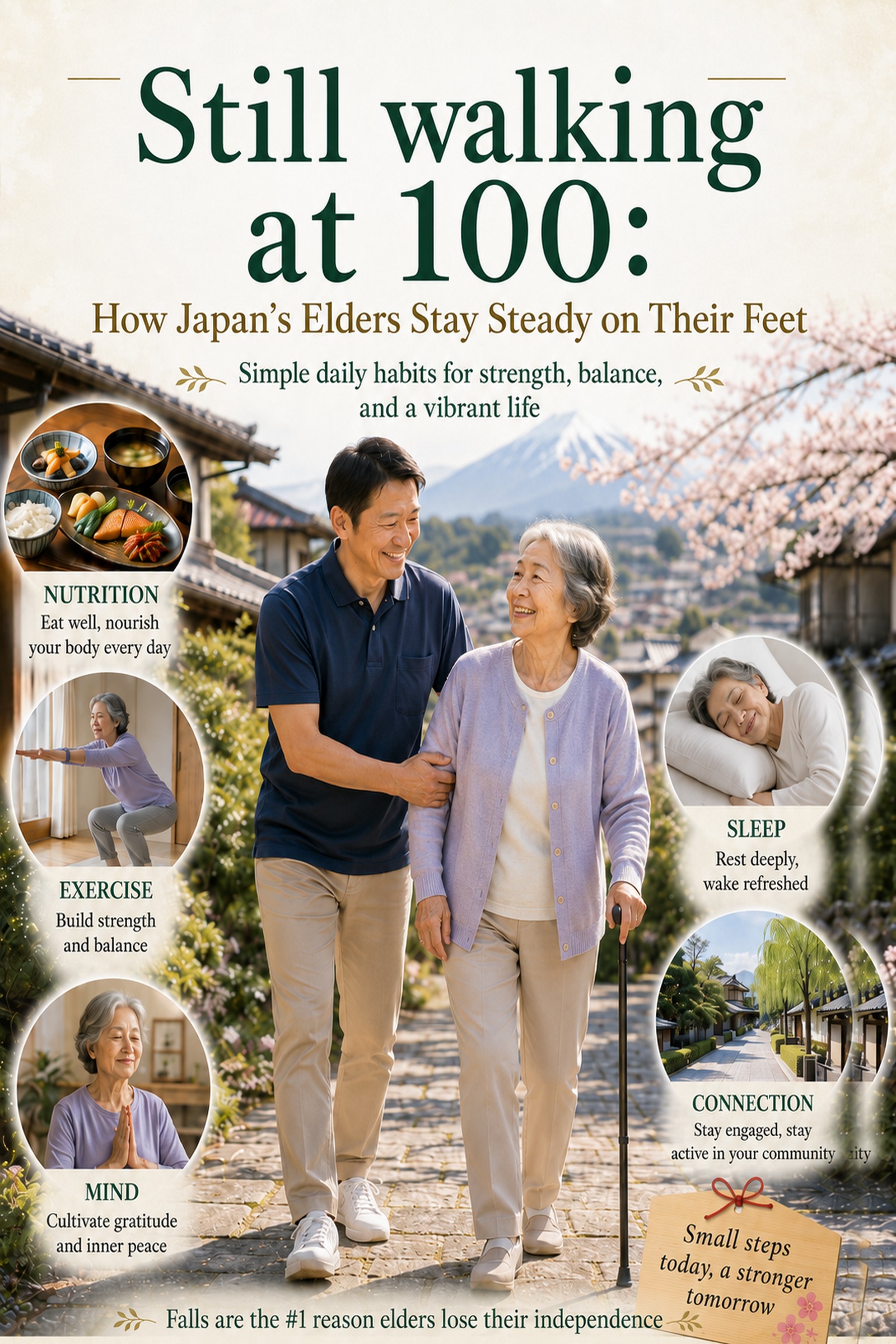
Still Walking at 100: How Japan’s Elders Stay Steady on Their Feet
Kindle $3.99 · free with Kindle Unlimited
Learn more
コメントを残す